
School Committee Approves Budget
By Cynthia Drummond for BRVCA
February 12th 2026
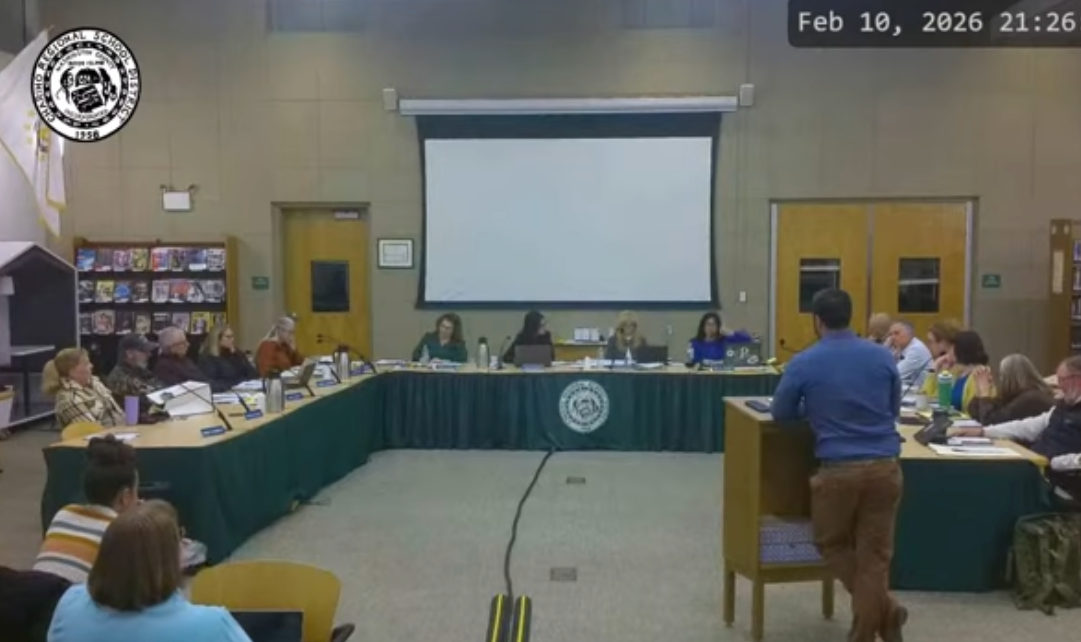
RICHMOND – The Chariho School Committee approved the proposed Fiscal year 2027 Chariho budget Tuesday. The committee will now consider further cuts to the spending plan, which totals, $62,223,858, a 4.99% increase, including state aid.
The committee also agreed to table a vote on the language of the $15 million capital improvement bond for a single unified elementary school and voted to send the Stage 1 application for the new school to the Rhode Island Department of Education.
The meeting was punctuated by disagreements over how the towns’ shares of the budget should be calculated, as well as a testy exchange between Hopkinton Town Manager Brian Rosso and Superintendent of Schools Gina Picard.
The “Thirds” Proposal
Under the Chariho Act, the contributions of the three towns are determined by their enrollment in the school district. Enrollment is fluid, so the contributions fluctuate from year to year, although Charlestown, with the lowest enrollment, about 23% this year, contributes the least.
The proposed contributions of the three towns in the new budget, before state aid, are:
Charlestown: $13,070,130, an increase of 5.02% over the current year
Richmond: $17,270,025, an increase of 7.82%.
Hopkinton: $16,143,089, an increase of 2.11%.
In what has become a chronic sore point between the towns, Richmond and Hopkinton have proposed that the towns divide the contributions into equal thirds while Charlestown refuses to consider the idea. The discussion has continued for several years.
Charlestown, the wealthiest of the three towns, has the lowest property tax rate, $5.93 per $1,000 valuation compared to Richmond, at $14.67 and Hopkinton at $15.29.
The question of the towns paying equal shares resurfaced at Tuesday’s meeting, during the discussion of the language of the capital improvement bond.
Member Diane Tefft, of Hopkinton, proposed that the three towns share the bond cost equally.
“I would like to make a motion in the language that all three towns must share the expense of the one new school equally,” she said.
Chariho Solicitor Jon Anderson noted that the Rhode Island General Assembly would consider the bond whether the towns’ shares were based on enrollment or divided in equal thirds.
“However you decide to do it, it will be incorporated in the bond language,” he said.
Anderson also noted that the General Assembly “typically follows the request of the community.”
The suggestion that the towns pay equal thirds, whether in their annual contributions or the capital improvement bond, faces strong opposition from Charlestown.
“Personally, I want to recommend that the Town Councils come to this decision,” Charlestown member Craig Louzon said. “For this group to force Charlestown to an equal third, I think you’re putting yourself at risk, liability-wise.”
Another Charlestown member, Linda Lyall, said,
“I don’t trust the towns, especially one, to actually support this new bond, so why should I trust that if I was magnanimous enough to say ‘okay, I think 1/3, 1/3, 1/3 would be fair,’ the bond would get passed. Are we all in on this? I don’t know.”
Charlestown Town Council President Deborah Carney told the committee that the town would oppose any initiative to divide the contributions into equal thirds.
“Charlestown will vehemently oppose you trying to inflict one third of the cost on us,” she said. “This is approximately a quarter million dollars a year, in addition to what we should be paying, based on the Chariho Act. We’re looking at approximately $7 million over the life of the bond, and my question for people that are advocating for this: would your town be willing to pay an additional quarter million dollars a year if you did not have to, if it was not what was required in the Chariho Act?”
Carney noted that state aid was “the equalizer” since Richmond and Hopkinton received more aid than Charlestown.
“Right now, Charlestown pays more per student than Hopkinton, and we pay more per student than Richmond,” she said. “…Rest assured, we are not going to sit by and let you subject us to paying a third, when it’s not what the Chariho Act says.”
The other towns were not swayed.
Immediately following Carney’s comments, Hopkinton Town Council President Mike Geary said it was time to reopen the Chariho Act, which would make it possible to reconsider how the towns contribute to the school district.
“This is a damn good time to re-think about open [sic] up the Chariho Act,” he said.
However, Richmond Town Council President Samantha Wilcox said she understood Carney’s arguments.
“While a one-third split on bond payments may seem reasonable for shared facilities and investments, it is not the formula established in the Chariho Act, as President Carney pointed out,” she said. “Charlestown already goes above and beyond in its support of the schools. The School Committee should decide together what is best for the district.”
The committee voted to table the vote on the bond language.
The Budget
The discussion opened with a statement from Picard who took exception to comments from a town official that there are errors in the proposed budget, as presented.
“It makes it look like we don’t have accurate information, which is not okay, because now, as your Superintendent, I need to ensure that accurate information is clearly articulated,” she said.
Committee member Jessica Purcell said she missed the summary page that used to be included with the budget.
She also commented that the new presentation was difficult to understand.
Hopkinton Town Manager Brian Rosso, who previously served as the town’s Finance Director, said the summary sheet on the budget, which is not included this year, had been helpful.
“The summary sheet in any sort of budget - in my professional career, there’s always a summary, right?” he said. “This budget is gigantic. We’re talking thousands and thousands of line items, so for the average person to digest that is impossible, so that’s where a summary sheet comes into play. At a high level, I think it’s easy for residents, taxpayers, School Committee members and everybody to digest.”
In doing his analysis of the proposed budget, Rosso said he had found an increase in Hopkinton’s share that was more than double what the town had anticipated from the numbers presented at the Omnibus meeting. He then contacted Director of Administration and Finance, Gregory Zenion for clarification.
“It’s very confusing,” Rosso said. “It’s not representative of what the town increase is. So, we’re looking at these percent increases, these dollar increases year over year at the Omnibus meeting that aren’t reflective of what we’re actually going to increase.”
Picard responded that voters approve or reject the budget, not specific numbers.
“This is where the confusion is coming in,” she told Rosso. “Voters don’t approve a number, they approve a budget. …So, that’s why, when you’re regional, you’re yes or no. It’s not about a number, because you can’t oversee that General Assembly. They have the power.”
Rosso suggested the numbers were misleading. Picard said his use of the word “misleading” was, itself, misleading,
but Rosso persisted, saying that he had been unable to reconcile the numbers for Hopkinton.
“Somewhere, it has to be illustrated what the actual …” he said, before Picard interjected that Rosso should have called her for an explanation. Rosso replied that he had contacted Zenion and Picard replied that he should have spoken with her.
Rosso, becoming visibly irritated, said,
“Why are you telling us how to operate?” he said.
“With all due respect, Brian, stop telling me how to operate,” Picard responded.
It was then that School Committee Chair Louise Dinsmore stepped in and ended the exchange.
“We’re all coming at this with the best of intentions. We are all trying to absorb and understand numbers. We have to approve a budget tonight,” she said.
The committee, with Dinsmore opposed, voted to approve the budget. Members will now consider further cuts as the process continues.
Wilcox said she hoped the discussions could take place without acrimony.
“We are all working to improve the balance of affordability and a strong school system and a clear explanation on what caused the difference would help us reach that goal,” she said. “This question and all questions on the budget deserve a transparent and collaborative conversation grounded in facts and free from accusations or hostility.”